
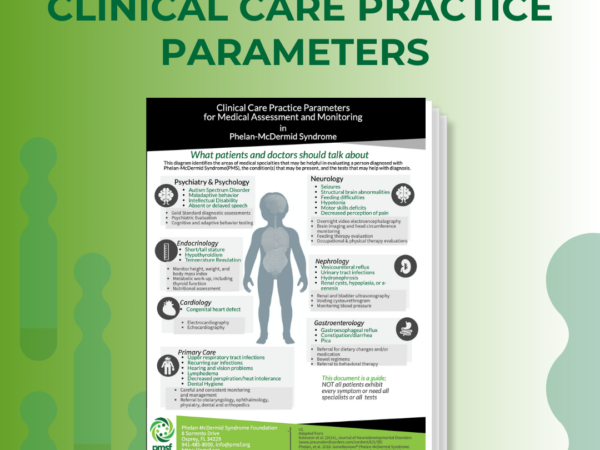
Parâmetros de Prática Clínica para avaliação e monitorização médica na Síndrome de Phelan-McDermid – Portuguese

Este diagrama identifica as áreas de especialidades médicas que podem ser úteis na avaliação de uma pessoa diagnosticada com a Síndrome de Phelan-McDermid (PMS), as condições que podem estar presentes, os exames que podem ajudar no diagnóstico e a abordagem multidisciplinar.
Continue ReadingParâmetros de Prática Clínica para avaliação e monitorização médica na Síndrome de Phelan-McDermid – Portuguese

Phenome‑wide profiling identifies genotype‑phenotype associations in Phelan‑McDermid syndrome

Phelan-McDermid syndrome is characterized by global developmental delay, intellectual disability, speech impairment, autism spectrum disorder, and hypotonia; other variable features include epilepsy, brain and renal malformations, and mild dysmorphic features. Here, we conducted genotype-phenotype correlation analyses using the PMS International Registry, a family-driven registry that compiles clinical data in the form of family-reported outcomes and family-sourced genetic test results.

Continue ReadingPhenome‑wide profiling identifies genotype‑phenotype associations in Phelan‑McDermid syndrome

Medical Advisory – Catatonia and Neuroleptic Malignant Syndrome (NMS)

The PMSF Medical Advisory Committee (MAC) would like to inform the patient community and the providers who care for them that around puberty or in early adulthood, some people with Phelan-McDermid syndrome are prone to developing bipolar disorder, associated psychotic features, and severe anxiety or obsessive-compulsive symptoms. Catatonia occurs in roughly 50% of Phelan-McDermid syndrome patients who develop psychiatric symptoms.

Continue ReadingMedical Advisory – Catatonia and Neuroleptic Malignant Syndrome (NMS)