2024 Research Grant RFA – Shannon O’Boyle Memorial Grant – Neuropsychiatric Illness
The PMSF Board of Directors has established an annual research grant of $100,000 in honor of Shannon O’Boyle and to acknowledge…


The PMSF Board of Directors has established an annual research grant of $100,000 in honor of Shannon O’Boyle and to acknowledge…
The objective of these updated clinical management guidelines was to: (1) reflect the latest in knowledge in PMS and (2) provide…
Autism spectrum disorder (ASD) is a neurodevelopmental disorder characterized by social communication deficits and restricted interests and behaviors which begin very early in life. In about a quarter of cases, the symptoms emerge about 18–24 months after a period of normal development, a phenomenon commonly described as early regression. However, marked functional decline can also occur in persons with autism after a relatively stable childhood.
Clinicians treating PMS individuals experiencing a neuropsychiatric event can use this form to reach out to the Neuropsychiatric Consultation Group. The…

The PMSF Medical Advisory Committee (MAC) would like to inform the patient community and the providers who care for them that around puberty or in early adulthood, some people with Phelan-McDermid syndrome are prone to developing bipolar disorder, associated psychotic features, and severe anxiety or obsessive-compulsive symptoms. Catatonia occurs in roughly 50% of Phelan-McDermid syndrome patients who develop psychiatric symptoms.
Data has emerged that a subset of individuals with Phelan-McDermid syndrome (PMS) experience devastating psychiatric symptoms, such as regression, bipolar disorder, and catatonia.
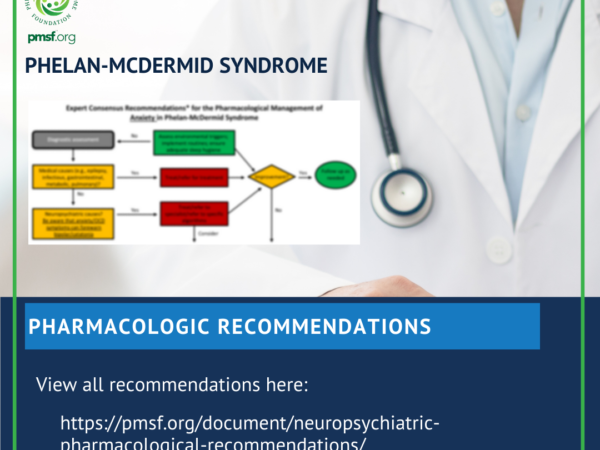
These PMS Pharmacological Recommendations were developed by the PMS_Neuropsychiatric Consultation Group (PMS_NCG). These algorithms describe treatment suggestions for PMS individuals who have PMS who also carry a diagnosis of ADHD, Sleep Disturbance, Irritability and Aggression, Mood Cycling, and/or Catatonia.