

Potential Blood-Based Biomarkers of Phelan-McDermid Syndrome
By: Meagan Hutchinson, PMSF Scientific Program Coordinator and Lauren Schmitt, PhD, PMSF Chief Science Officer
Date: June 10, 2026
An important note before we begin: SHANK3 is both a gene and a protein! The SHANK3 gene is located on chromosome 22. A gene is like a recipe; it contains the instructions for making something. The SHANK3 protein is made by following those instructions, so it’s like the meal that comes from the recipe. When the SHANK3 gene is disrupted, like in Phelan-McDermid syndrome, the recipe is missing pieces or contains errors. As a result, the cell cannot make enough SHANK3 protein.
The SHANK3 protein is needed to help support the connections between brain cells, called synapses. Thus, with less SHANK3 protein, the brain connections (or “synapses”) do not form and function properly, making it harder for brain cells to communicate effectively.
One final note: Scientists use slightly different formatting to differentiate between the gene and the protein. The gene name is usually in italics (SHANK3), whereas the protein is written in normal typeface (SHANK3).
What Did the Study Do?
In a recent study, Dr. Tobias Böckers’ lab at Ulm University in Germany recently explored whether certain proteins found in blood samples could serve as biomarkers for Phelan-McDermid syndrome. Biomarkers are measurable clues in the body that may help researchers better understand disease severity, track progression over time, or monitor how well a treatment is working. For example, blood sugar is a biomarker for diabetes and cholesterol is a biomarker for heart disease.
In this pilot study, the researchers examined blood samples from 23 individuals with Phelan-McDermid syndrome and compared them to typically-developing controls.
What Did the Study Find?
The study found two proteins that differed between those with and without Phelan-McDermid syndrome:
- SHANK3 — the protein product of the SHANK3 gene and known to be reduced by approximately 50% in Phelan-McDermid syndrome
- Beta-synuclein — a protein linked to communication between brain cells
SHANK3 levels (detected in specialized white blood cells) were significantly lower in individuals with Phelan-McDermid syndrome than typically-developing controls. People with Phelan-McDermid syndrome who had a history of loss of skills/regression had lower SHANK3 levels than those with Phelan-McDermid syndrome who did not have history of loss of skills/regression. This suggests the SHANK3 protein may help monitor disease changes or treatment effects in the future.
Beta-synuclein levels (detected in plasma) were higher in individuals with Phelan-McDermid syndrome than controls. People with Phelan-McDermid syndrome who were non-vocal speakers or had single words had higher levels of beta-synuclein compared to those who had sentence speech. This suggests elevated beta-synuclein levels may reflect dysfunction in synapses, which could have downstream impact on speech and language in Phelan-McDermid syndrome.
Consistent with findings in individuals with Phelan-McDermid syndrome, the Shank3 mouse model also had reduced SHANK3 protein and increased beta-synuclein compared to wild-type, or control, mice.
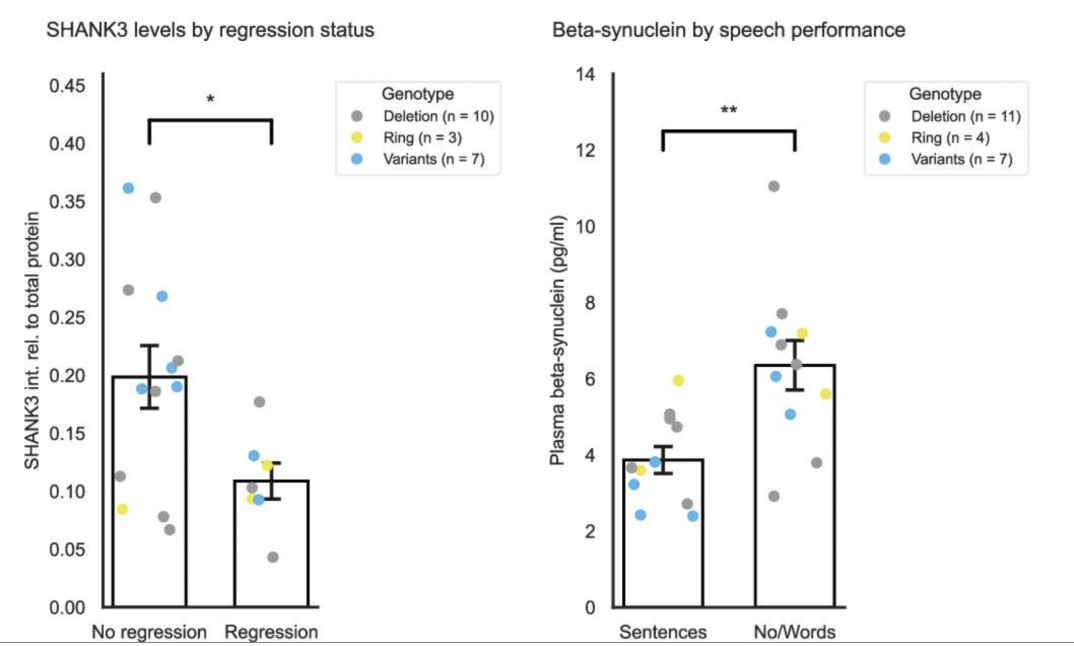
Figure 3B from Pagano et al., 2026. Left graph depicts SHANK3 protein levels in participants who have a history of “No Regression” versus “Regression. On average, individuals with a history of regression have higher SHANK3 protein levels than those without a history of regression. Right graph depicts beta-synuclein levels in participants who have sentence speech versus those who have no words or single words. On average, individuals who have more complex verbal language have lower beta-synuclein. Asterisks indicate statistical significance. Individual dots represent one participant, color-coded based on genotype.
What Are the Limitations?
- This is a pilot study involving only a small number of participants, meaning larger studies are needed to replicate findings in a larger number of individuals with Phelan-McDermid syndrome.
- The biomarkers were identified in peripheral blood, meaning we do not know whether similar findings would be found in the brain.
What Does This Mean and What’s Next?
Overall, this pilot study suggests that SHANK3 protein and beta-synuclein could be potential blood-based biomarkers for Phelan-McDermid syndrome. Although additional research is needed in larger groups of individuals and to track over time, this study is a really encouraging and exciting step towards developing objective biological measures for Phelan-McDermid syndrome research and future treatment development!
Study link: Pagano J, Perez Arevalo A, Nosanova A, Bauer HF, Loth E, Andres S, Becker F, Otto M, Stefanoni A, Verpelli C, Oeckl P, Schön M, Boeckers T. SHANK3 and beta-synuclein are novel blood-based biomarkers for the Phelan-McDermid Syndrome: a pilot study. Transl Psychiatry. 2026 Mar 24;16(1):201. doi: 10.1038/s41398-026-03932-8. PMID: 41876457; PMCID: PMC13039877.