
US Updated consensus guidelines on the management of Phelan–McDermid syndrome
The objective of these updated clinical management guidelines was to: (1) reflect the latest in knowledge in PMS and (2) provide…


The objective of these updated clinical management guidelines was to: (1) reflect the latest in knowledge in PMS and (2) provide…

This EL-PFDD meeting was modeled after the work of the FDA’s Patient Focused Drug Development (PFDD) initiative. PFDD is a systematic way of gathering patient perspectives on their condition and on available treatments. The information gathered at the meeting is presented in this Voice of the Patient report, a high-level summary of the perspectives generously shared by the families and caregivers of individuals living with PMS, who participated in the November 8, 2022, EL-PFDD meeting. The report also includes selected comments that were submitted through an online portal.
In 2001, Katy Phelan and Heather McDermid described the clinical and cytogenetic characteristics of 37 people with a 22q13.3 deletion(Phelan et al., 2001). The 22q13.3 deletion syndrome was since then referred to as Phelan-McDermid syndrome (PMS) (OMIM#606232).Later on, the deletion of a single gene, i.e. SHANK3 (OMIM#606230),was found to be responsible for the majority of the clinical features.Individuals with a pathogenic variant in SHANK3 appeared to have a similar phenotype, that is also referred to as Phelan-McDermid syndrome (Schon ¨ et al., 2023, this issue; Vitrac et al., 2023, this issue). Sincenot all individuals referred to in the original publication of Phelan and McDermid may have had a deletion 22q13.3 including SHANK3 there has been some debate on how the phenotype should be called whenSHANK3 is not involved. Consequently, a distinction in different types ofPhelan-McDermid syndrome has been proposed: PMS SHANK3-relatedand PMS SHANK3-unrelated (Phelan et al., 2022).

Phelan-McDermid syndrome is a genetic condition primarily caused by a deletion on the 22q13.3 region or a likely pathogenic/pathogenic variant of SHANK3. The main features comprise global developmental delay, marked impairment or absence of speech, and other clinical characteristics to a variable degree, such as hypotonia or psychiatric comorbidities.
Altered sensory functioning is often observed in individuals with SHANK3 related Phelan-McDermid syndrome (PMS). Compared to typically developing individuals and individuals with an autism spectrum disorder, it has been suggested that there are distinctive features of sensory functioning in PMS.
Individuals with Phelan-McDermid syndrome caused by a 22q terminal deletion and a ring chromosome are at increased risk for Neurofibromatosis type 2 (NF2). However, the prevalence of NF2 in individuals with PMS and a r (22) is unknown.
This resource is authored by Katy Phelan, PhD., et al Ring chromosome 22 is a rare genetic condition resulting when one…
Do you wonder how a research publication affects your loved one or the field of Phelan-McDermid research? The Research Roundup is…
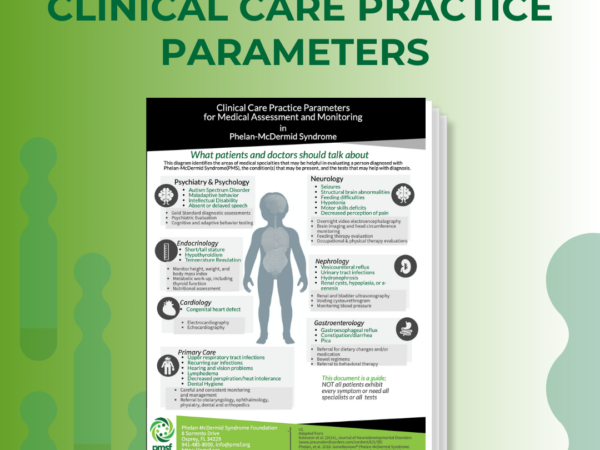
The Clinical Care Guidelines infographic is a tool that can be used by patients to begin discussions with their own clinician. Please note that all cases of PMS are different and your doctor/clinician is the best resource to help you make clinical care decisions for your loved one.
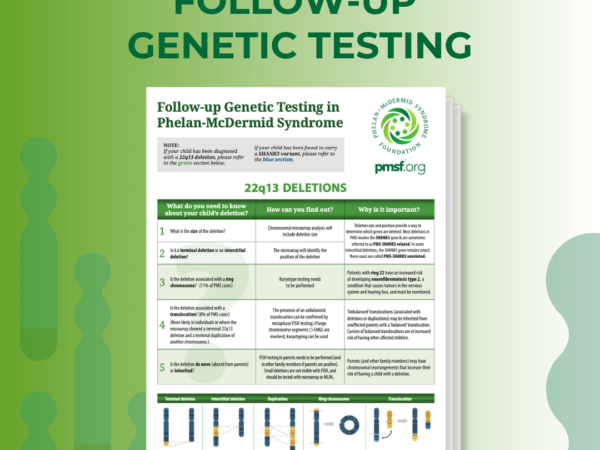
A graphic explaining possible reqirements for follow-on genetic testing