

By: Meagan Hutchinson (PMSF Scientific Program Coordinator) and Lauren Schmitt, PhD (PMSF Chief Science Officer)
Date: May 20, 2026
What Did the Study Do?
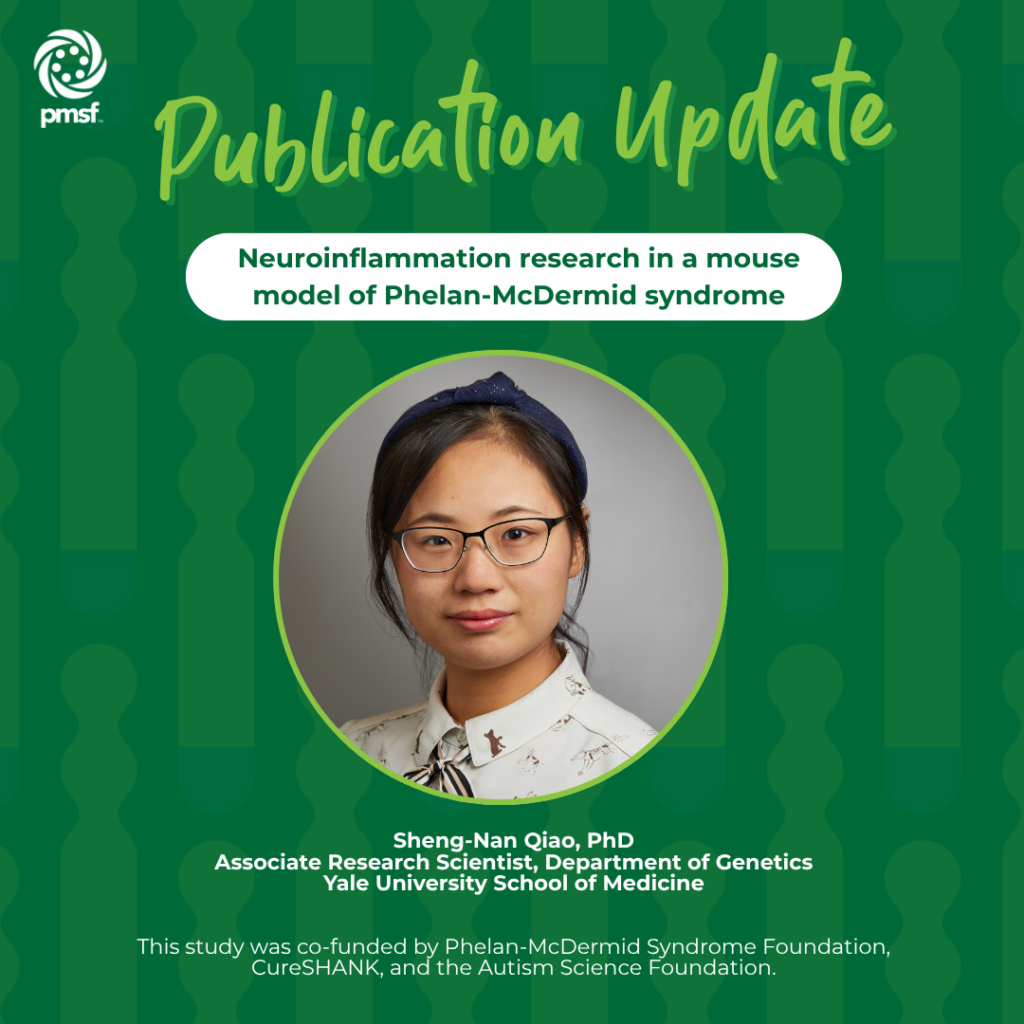
Inflammation is the body’s natural immune response to injury or infection. Researchers at Yale University investigated whether inflammation in the brain, known as neuroinflammation, could contribute to behavioral changes in a mouse model of Phelan-McDermid syndrome. The mouse used was missing one copy of the Shank3 gene, a condition called haploinsufficiency, resulting in reduced levels of the protein needed for normal brain function.
To study the effects of neuroinflammation, researchers exposed the mice to lipopolysaccharides (LPS), molecules found on the outer surface of certain bacteria that can trigger an immune response and inflammation.
What Did the Study Find?
The researchers found that mice with Shank3 haploinsufficiency were more vulnerable to neuroinflammation, as demonstrated by changes in behavior, including motor difficulties, anxiety-like behaviors, and repetitive behaviors.
The researchers also observed that immune cells in the brain, called microglia, became overactive after inflammation and impaired synaptic function, or the communication between brain cells. Thus, these changes may disrupt normal brain signaling and contribute to behavioral changes.
They also tested an anti-inflammatory treatment in these mice called mefenamic acid, which is a nonsteroidal anti-inflammatory drug (NSAID, like ibuprofen). This treatment improved the motor behaviors worsened by LPS in the Shank3 mice, particularly among female mice, hinting at possible sex-specific effects.
What Does This Mean and What’s Next?
This is the first study to demonstrate loss of skills in a pre-clinical model of Phelan-McDermid syndrome as well as the rescue of lost skills via an anti-inflammatory treatment. These findings suggest that neuroinflammation may worsen neurological and behavioral symptoms associated with SHANK3 deficiency, and could be one biological explanation of the loss of previously-acquired skills or regression that occurs in some individuals with Phelan-McDermid syndrome. This study also demonstrates that loss of skills can be modeled in animals (at least via inflammation), opening the door for additional pre-clinical research to better understand the link between immune function, inflammation, and Phelan-McDermid syndrome.
Previously, a small case study reported that four females with Phelan-McDermid syndrome who experienced regression of skills following a possible viral infection benefited from immunomodulatory treatment (e.g., IVIG). Although this raises important questions about the broader use of IVIG in Phelan-McDermid syndrome, the current consensus guidelines highlight its use only for those with positive autoantibodies from either CSF or serum.
Overall, more research is needed to examine whether anti-inflammatory and immunomodulatory treatment strategies address behavioral regression and loss of skills in Phelan-McDermid syndrome. The Phelan-McDermid Syndrome Foundation has been at the forefront of research in this area thus far. The current study was co-funded by Phelan-McDermid Syndrome Foundation as well as by CureSHANK and the Autism Science Foundation. Dr. Sheng-Nan Qiao, lead author on the study, shared, “I am deeply grateful for the opportunity to be part of this project. This work was inspired by clinical observations seeking to provide mechanistic insight into [Phelan-McDermid syndrome]. While much remains to be explored, I hope it contributes to a better understanding of the disorder and helps pave the way for future therapeutic advances.”
Additionally, the Phelan-McDermid Syndrome Foundation is funding two projects through our PMSF Research Grants Program examining the role of the immune system in Phelan-McDermid syndrome. Check out our podcast episodes with Drs. Milena Andzelm and Jonathon Santoro describing their projects.
Want to know more about the study?
Check out the full study here! Plus Dr. Qiao will be presenting at the 2026 PMSF Family Conference!
Want to participate in neuroimmune research?
Dr. Santoro’s team is currently enrolling for “Profiling Responses and Immune Signatures in SHANK3-Mediated Neuropsychiatric Disease (PRISM)”. Check it out on our Current Open Studies page!